Demosciocracy — The Power of the Chambers and the Executive
1. The Territory: the fundamental basis of power
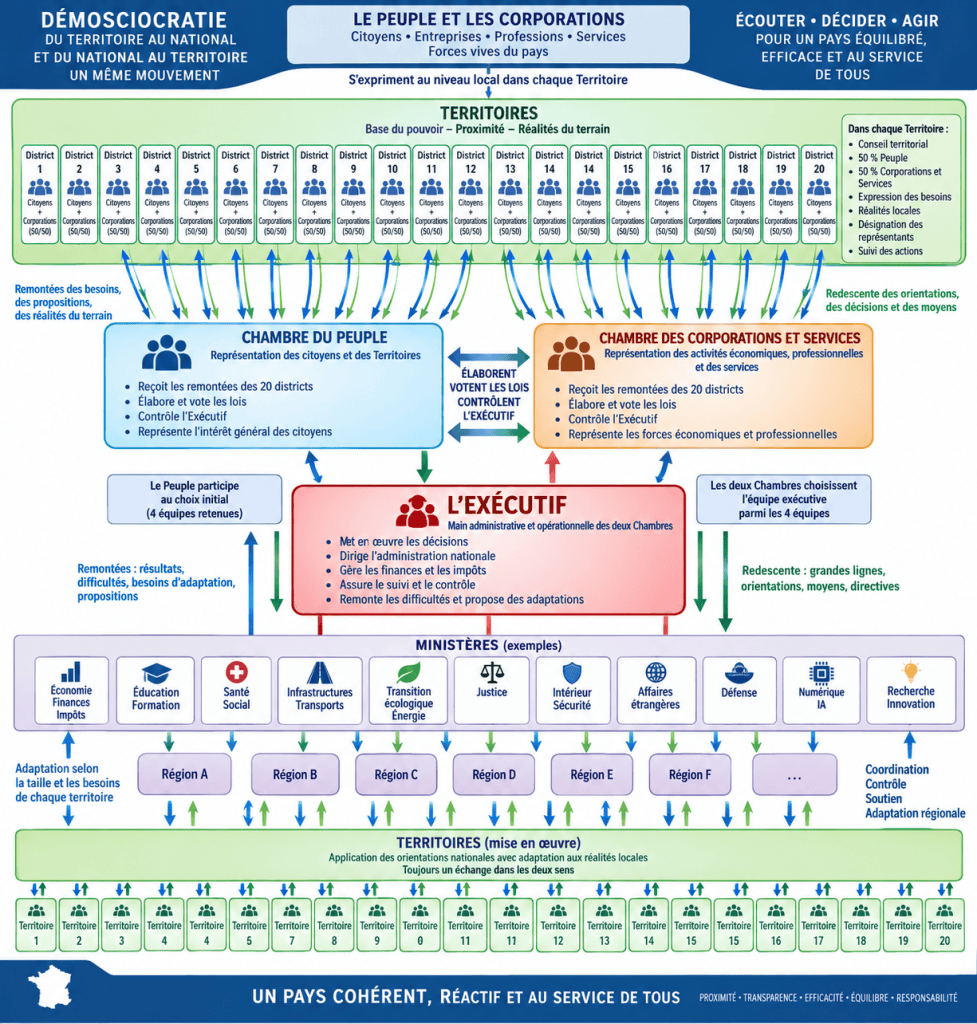
Demosciocracy rests first and foremost on the Territory. It is the fundamental unit of representation, organisation and communication of the population’s needs.
Each Territory has its own Council, formed according to the fundamental principle of balance:
50% representatives of the People and 50% representatives of the Professional Bodies and Services, representing the Territory’s economic and professional activities and active forces.
This organisation must never be reversed: power starts in the Territory and rises towards the national institutions.
Each Territory therefore appoints its representatives to the two national Chambers:
- the Chamber of the People, directly representing citizens and Territories;
- the Chamber of Professional Bodies and Services, representing professional and economic activities and the services society needs.
As representatives are replaced according to the annual principle provided for by Demosciocracy, the Chambers are continually renewed from the grassroots. They therefore do not form a permanent political class.
2. The two Chambers: the centre of national power
The two Chambers bring together representatives of all French Territories.
Together, they constitute the national decision-making centre.
They develop common rules, define the country’s broad direction, determine national missions and oversee their implementation.
The principle is simple:
The Territories communicate their needs; the Chambers compare and organise them and make decisions; the Executive implements those decisions.
There must be a constant flow in both directions.
Territories → Chambers → Executive → Territories
But also:
Territories → Executive → Chambers
Thus, when a national decision encounters difficulties in its implementation, information must be able to flow back immediately. The Executive then presents the difficulties identified to the Chambers and may propose adjustments.
However, it does not decide alone on a new fundamental direction: that decision belongs to the two Chambers.
3. Recruiting the Executive
The Executive does not come from a permanent political class.
Teams capable of providing the country’s executive leadership publicly present their organisation, skills, methods and ability to fulfil the missions defined for the country.
Recruitment takes place in two stages.
In the first stage, all French citizens take part in a national vote. This vote selects the four leading teams.
In the second stage, the two Chambers examine these four teams and choose the one that will be entrusted with responsibility for the Executive.
The People therefore participate directly in the initial selection, while representatives from all the Territories make the final choice.
The selected team does not thereby receive power independent of the Chambers.
It receives a mission of implementation.
4. The Executive’s function
The Executive is the administrative and operational arm of the two Chambers.
Its fundamental function is to turn their decisions into concrete action.
It directs the national administration needed for this implementation, coordinates the major common missions and passes national directives to the bodies responsible for carrying them out.
It must also ensure the reverse flow: gathering difficulties, results, needs and proposals from the Territories and presenting them to the two Chambers.
The Executive therefore has the ability to make proposals based on its experience of implementation.
But proposing is not deciding.
When it believes that a rule should be changed, an organisation is working poorly or expenditure is unnecessary, it informs the Chambers, supplies the necessary evidence and may propose a solution. The Chambers decide.
The Executive then implements that decision.
5. Accountability and removal from office
The Executive remains accountable to the two Chambers at all times.
It has no guaranteed period of power that would allow it to oppose them over the long term.
If it no longer carries out its missions correctly, departs from the Chambers’ decisions, becomes ineffective or is found to have committed serious misconduct, the two Chambers may terminate its duties under the constitutional rules provided for.
The principle must be one of constant accountability:
An office continues for as long as it is properly exercised.
The same logic must apply to the principal officials under the Executive’s authority.
6. Territories and Regions: two different functions
The Region must not become a political level above the Territory.
The Territory remains autonomous within its powers and forms the basis of Demosciocracy.
The Region primarily serves as an intermediary for organising, coordinating and overseeing certain major national missions when an organisation extending beyond a single Territory is necessary.
Education provides an example.
The two Chambers determine the broad common directions: fundamental knowledge, national objectives, training requirements and principles that make general equality between citizens possible.
The Executive organises their implementation.
Regions may provide the coordination and oversight necessary for that implementation.
But Territories retain the ability to communicate their realities, difficulties and needs.
The system therefore never operates solely from the top down.
It constantly works in both directions.
7. Defence and major national functions
Some missions naturally require a single national organisation.
Defence and the armed forces are the main example.
They are subject to the direction and oversight of the two Chambers, with operational implementation entrusted to the Executive and the competent professional bodies.
Other major common functions may follow a comparable organisation when the interests of the whole country require unified operation.
However, the Constitution will have to distinguish precisely what genuinely belongs at the national level and what must remain the responsibility of the Territories.
8. A deliberately light national administration
Demosciocracy must avoid multiplying administrations, bodies, commissions and agencies whose functions overlap.
Every administrative structure must correspond to an identifiable and necessary mission.
When a body no longer has a demonstrable purpose, when its function can be performed by an existing structure or when it duplicates administrative work, it must be possible to abolish it.
The administration is a tool serving the population, not an organisation intended to ensure its own permanence.
Digital technologies and artificial intelligence may make it possible to automate a significant proportion of administrative tasks, checks and information exchanges.
The objective is twofold: to achieve effective oversight while considerably reducing unnecessary formalities for citizens and businesses.
9. Finances, taxes and redistribution
Under the authority of the two Chambers, the Executive also organises the collection of national resources.
The level of taxation must be limited to what is necessary to carry out the collectively decided missions.
Revenue must then be allocated and redistributed under transparent rules that provide for:
The operation of common services, national missions, the resources needed by the Territories and essential solidarity between the different parts of the country.
The Chambers determine the rules and oversee their application.
The Executive collects, administers and redistributes in accordance with those decisions.
Information systems and artificial intelligence must enable continuous oversight of financial flows and reduce administrative costs, without multiplying the burdens on businesses and citizens.
10. The general principle of the demosciocratic Executive
The whole system can ultimately be summarised by this chain:
THE PEOPLE AND THE PROFESSIONAL BODIES → THE TERRITORIES → CHAMBER OF THE PEOPLE + CHAMBER OF PROFESSIONAL BODIES AND SERVICES → DECISION AND DIRECTION → EXECUTIVE → ADMINISTRATIVE AND NATIONAL IMPLEMENTATION → REGIONS AND TERRITORIES ACCORDING TO THEIR POWERS → RESULTS, NEEDS AND DIFFICULTIES → FEEDBACK TO THE EXECUTIVE AND THE TWO CHAMBERS
The essential principle is therefore:
The Territories form the basis of power. The two Chambers, drawn from the Territories, decide common directions. The Executive, recruited with the People’s participation and then chosen by the two Chambers, administers and implements their decisions. It reports to the Chambers at all times and may propose adjustments made necessary by its experience of implementation.
 DEMOSCIOCRACY/ DEMOSCIOCRATIE
Vous devez être connecté pour poster un commentaire.